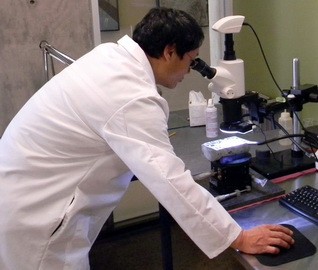
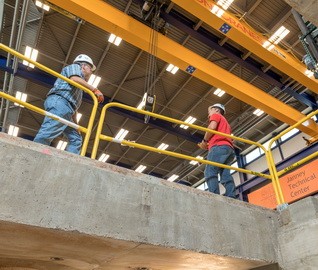
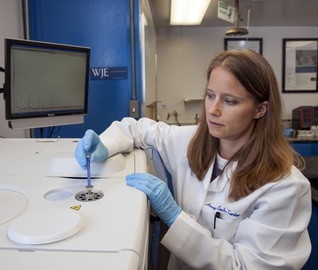
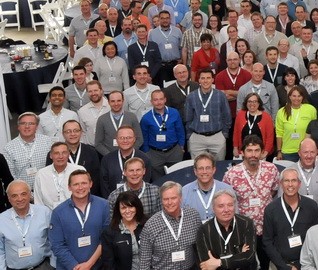
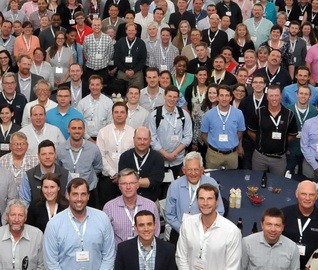
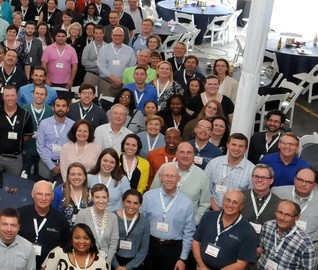
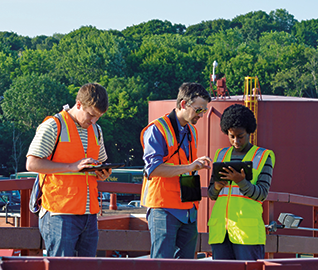
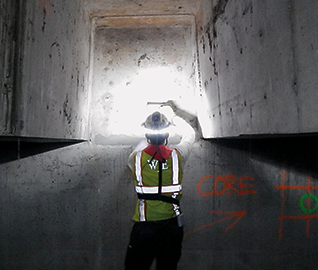
Last May, eight hundred WJE employees gathered at our corporate headquarters campus for the final day of our all-company conference. Inside our structural laboratory, staff were greeted by a two-story, steel-framed structure dubbed the “Building in a Building.” Designed as a hands-on learning opportunity, the full-scale building mockup was constructed with more than a hundred intentional defects demonstrating the structural and enclosure-related issues we encounter on real projects. At the close of the conference, after all staff had thoroughly explored the Building in a Building, we load-tested the structure to failure.
Then, the real fun began.
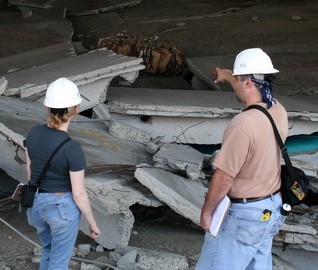
Over two days, seven members of our failure investigation practice group worked together, using the skills they’ve developed from past projects, to investigate the structure’s failure—which (spoiler) did not go exactly as planned. And a film crew captured it all so we can all learn from their experience.
This webinar is a deep-dive inside a 'typical' failure investigation, beginning with a documentary-style video following the team’s progress—from design, construction, and collapse through the initial site safety assessment to field documentation using a variety of advanced technologies The video is followed by a live panel discussion and Q&A with the project team. This is a great opportunity for students, educators, and other interested parties to delve into the failure investigation process and mindset—complete with all the practical constraints, unexpected challenges, and key decision-making points that engineers encounter on real-life projects.
more to learn
View this webinar in our interactive audience console to earn 1 AIA HSW learning unit, access related resources, submit questions to the presenters, and download a certificate of completion.
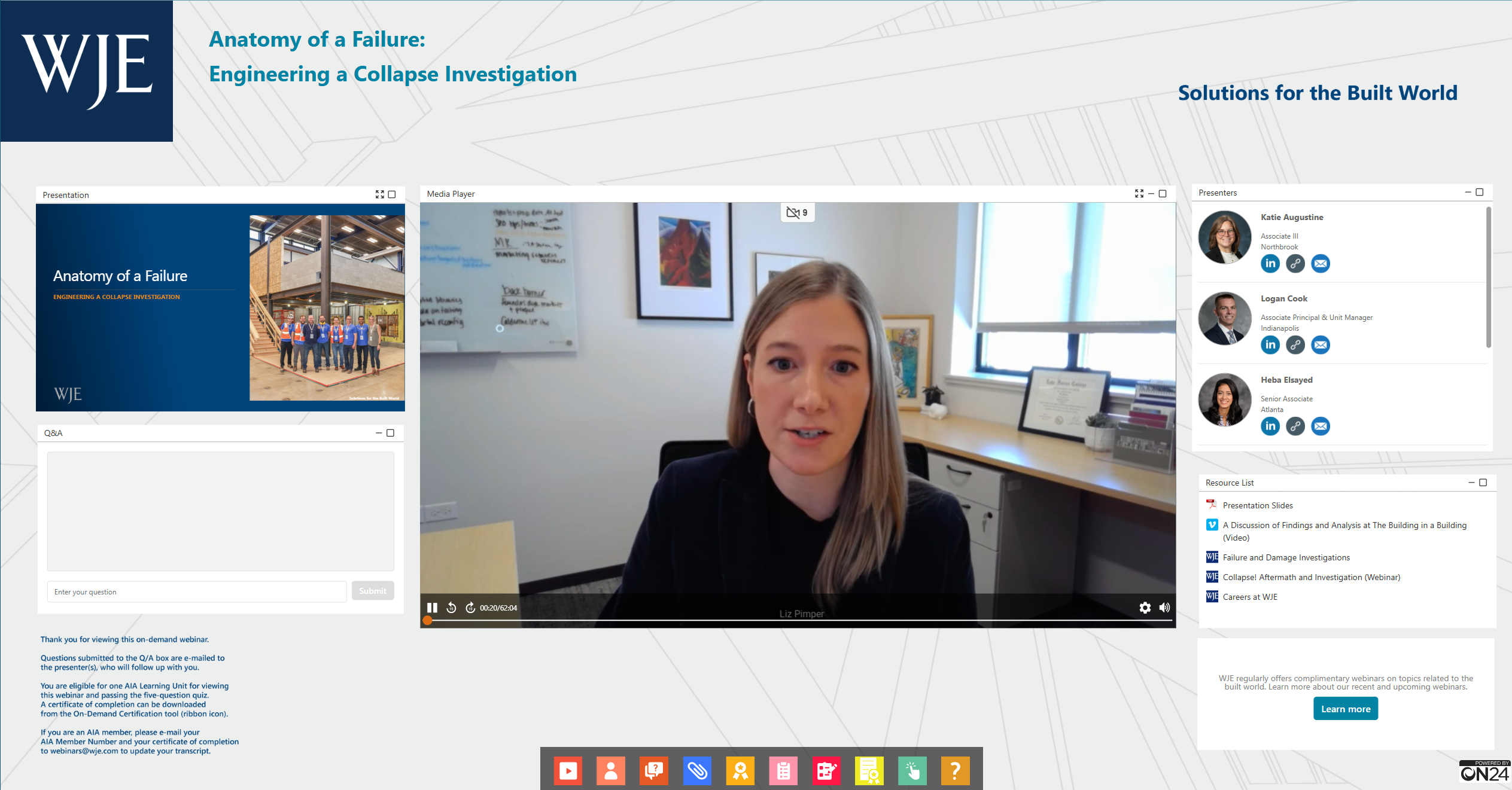
Logan J. Cook, Associate Principal and Unit Manager
Heba S. Elsayed, Senior Associate
Ross J. Smith, Principal
Steven H. Zimmerman, Principal and Executive Director of Talent Advancement
Liz Pimper
Hello everyone. Welcome to today's WJE webinar, Anatomy of a Failure: Engineering a Collapse Investigation. My name is Liz Pimper and I'll be your host. During the next hour, we will delve into the failure investigation process and mindset, starting with a documentary style video following a team of WJE engineers investigating the collapse of a two-story building constructed inside our structural laboratory. We'll see how this project progressed from design, construction, and collapse through the team's initial site safety assessment and field documentation. After the video, Steve Zimmerman, a principal and director of the Janney Technical Center will moderate a live panel discussion and Q&A with the project team. This presentation is copyrighted by Wiss Janney Elstner Associates. And now I will turn it over to Steve to get us started.
Steve Zimmerman
All right. Thank you, Liz. Good afternoon everyone and we are so happy that you could join us for this webinar this afternoon. I'm Steve Zimmerman. I'm the director of our Janney Technical Center, which is WJE's main laboratory facility here in Northbrook, Illinois. I'm also WJE's Executive Director of Talent Advancement. And today's presentation really highlights both the unique capabilities of the laboratory, our JTC, and also our commitment to sharing our knowledge and developing our internal expertise. So over the next hour, we hope to give you a better understanding of the field of forensic engineering, show you what's involved with the collapse investigation and give you a sense of WJE's problem solving practice.
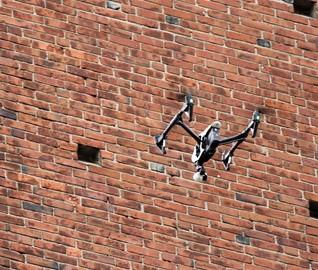
So let's start with some specific learning objectives. So by the end of the presentation, we hope that you'll be able to list typical steps an engineering team takes during a collapse investigation, plan for safe access on a job site prior to arrival, including identifying potential hazards, using appropriate PPE and determining which areas are safe to access. Identify available technologies such as drones or photogrammetry for safely documenting the condition of a partially collapsed building and describe strategies and available technologies for a team to use to collaborate and communicate during the onsite investigations. So for those of you who are unfamiliar with WJE, we're a global firm of engineers, architects, and material scientists who are committed to helping our clients solve, repair and avoid problems in the built world. We were founded in Northbrook, Illinois in 1956 and over almost 70 years as WJE, we've currently have 30 locations, over 800 employees and work on almost 10,000 projects every year.
And one of our core services is failure and damage investigation. And over our history, we've earned a reputation for quickly responding to catastrophic events and we've used all of our unique capabilities and range of expertise to help determine the cause of structural failures, the extent of damage, and help design repairs that might be needed to help our clients restore their facilities to operation. Before we get into the failure investigation we're going to talk about today, we're going to provide a little bit of background about the special project that's really going to be the focus of the webinar. And it's something that we refer to as our building in a building or the BIB. The building in a building was a key feature of our WJE company-wide conference that was held in May of last year. As part of that conference, we brought all 800 members of our staff together for three days of learning, discussion and development.
One of the goals of the conference was to share knowledge and develop our expertise by discussing collaborating and sharing our experiences. And we did that in several different ways. On the first day and a half, everybody attended presentations and participated in discussion sections on discussion topics that were related to many of our unique practice areas and our work processes. And then for the last day, we brought everybody to our company headquarters here in Northbrook to have a one of a kind learning experience. Here on campus, our staff had set up 60 stations throughout our laboratory and facilities that showcased our various capabilities. They were able to try new equipment and get a hands-on experience related to our many practice areas. The collection of these stations was called the Ask the Structure Experience, which highlights a key phrase that one of our founders, Jack Janney, coined early in our history.
And it really describes WJE's approach to problem solving. Ask the structure. The centerpiece of the Ask the Structure experience was a two-story building that had been constructed inside our structural testing laboratory. And this became known as the building in a building. The building in a building was intentionally constructed with dozens of examples of defects and damage so that it would serve as an interactive exhibit, allowing staff to explore the building and see firsthand many common issues that WJE encounters in the course of our typical projects. It served as a great opportunity for staff in one function or practice area to be more aware of what staff in other practice areas might experience on a project by project basis. And at the end of the conference, everybody gathered together in a tent on WJE's campus for the president's final closing remarks and also a surprise as we all watched a live stream from the structural lab as WJE engineers and technicians load tested the building that we were all in earlier in the afternoon.
But instead of a complete collapse, the load test resulted in a partial failure of the second floor as shown in this photograph. And you may be wondering why did we decide to do this? Why would we construct and put all the time and effort into building this building just to collapse it? But if you recall, the building was built as a learning and development tool for our staff and the load test and what served and followed after was equally as important of a learning tool. WJE is committed to continuing our legacy for collapse investigation by making sure that we continue to grow and expand our skills and pass them on to the next generation of engineers and architects. So in that spirit, we asked one of the leaders of our failure investigation practice, Ross Smith, who you get to meet later to assemble a team of engineers to stay behind after the conference and investigate the collapse that was just orchestrated.
We wanted that team to treat this just like a real life project and make it as real as possible. And as a result, we kept the collapse a surprise to all those team members so they weren't aware of what was going on or what they were going to be getting into after the conference ended. So after the load test, the investigation team dove in and put their skills to work all while a film crew followed them around to document the investigation and the related work. Using that video, findings from the investigation and thoughts from the team members, we put together a four-part webinar series so that all WJE staff could see how the investigation went. Those webinars became a great resource to help us share our knowledge about responding to collapse investigations, how we mobilize everyone quickly, what unique safety considerations are necessary, how we collect and share information in an efficient way and quickly, and how do we start to make sense of all the observations, information and data once we're back in the office.
And so today we're excited to share this unique experience with you and give you a peek into the world of collapse investigations. We've put together a short documentary about the building in a building and the subsequent investigation. We also have several investigation team members here with us today. So after the video, and you'll get a chance to ask them some questions about what it's like to work on these types of projects or what it was like to work on the building in a building collapse specifically. And so now we're going to roll the video and then we'll be back afterwards to take some of your questions.
Mohamed ElBatanouny
When the idea came, it was let's build a building that's two story high at some defects in it. And then after everyone is gone, load test it and get a failure.
Steve Zimmerman
The building in the building really was the idea of building a whole structure inside our structural lab and then doing some physical load test to it.
Andi Mele
I remember the first day that Mohamed and Jon Stricker, they came into my office and they said, "We have this idea. We want to do this building in a building." And we went right to the whiteboard and we started sketching out just a rough sketch of what we thought that the bib could look like.
Jon Stricker
It's pretty clear that a steel moment frame would serve the most flexible because it has the most openings and can be adapted with the most other structural systems. From there, we were interested in highlighting as many different systems as possible. We have light gauge, we have wood, we have masonry, concrete in the foundations, open web steel joists, just a whole lot of systems to try and show the variety of things we work with here at WJE.
Andi Mele
And then it got a little bit more complicated from there.
Jon Stricker
Not only did I have to design something that could stand for the two or three hours that people would be exploring it, but could be changed in about a 30-minute period such that we could pull on it with a minimal amount of load and cause a partial collapse.
Mohamed ElBatanouny
So just construction, that was a top secret in the company. Not a lot of people know what we were doing. So we tried to keep it that way all the way through the construction phase.
John Pearson
The biggest challenge, it was more of coordinating the failure. The most concerning thing was that we had a short period of time to make the failure occur.
Mohamed ElBatanouny
It was very important for us to keep this a controlled failure as much as possible. We did not want the whole frame to collapse because that would damage our structural left floors, which are very important for us. So what we wanted to do is basically pull the two steel beams on the second floor that support the second floor, do it as safely as possible.
John Pearson
There was some connection between the three different floor systems, but they ended up having a catenary reaction to it and just suspending the beams. We thought the beams would just come down. There were other load paths that found their way through it and kept the floor from completely dropping.
Jon Stricker
Having that unstable partial collapse is almost more interesting and I think may have made the job of the collapse investigation team a little bit more tricky, but hopefully more rewarding.
Ross Smith
We put together a team. We just wanted a great team, people that sort of know each other, but don't know what's going to happen. And I picked a team from around the country.
Katie Augustine
I was brought into this without knowing anything about it. Ross just kind of called me one day and was like, "I've got kind of a fun idea and I want you to be a part of the team, but I can't tell you a thing about it. Do you want to do it? " So naturally I said, "Yeah, of course."
Matt Desimone
I got a call from Ross and he was calling me up to ask if I'd be interested in something that would be really cool, but he couldn't tell me what it was.
Josh Boggs
Ross reached out to me on Teams, "Hey Josh, I've got something to talk to you about. I need you to use our technology to help with a collapse." I was like, "Well, yeah, I can absolutely help with that. Wow. Where's the collapse? How can I help?" "Well, it hasn't happened yet. It's going to happen at the conference.
Katie Augustine
"I got to the conference and we were walking around the Northbrook campus. And of course we get into the lab and there's just building in a building.
Logan Cook
As I walked through asked the structure experience, I actually walked through the building and it was bigger than I was imagining it would be.
Katie Augustine
We get into the tent that's in the parking lot and as soon as they cut to the JTC, I was like, "Oh, they're going to do something. This is really cool."
Justin Barden
Watching the video, it was pretty exciting and I started to have a hunch on what we're going to get involved with.
Katie Augustine
So they start pulling on the column and I'm sitting there and the light bulb in my head, I was like, "Oh my God, I get to look at that. "
Heba Elsayed
When they introduced that they're actually going to try to collapse the structure, I was pretty shocked. And that kind of clued me in a little bit of maybe our secret mission is something to do with the building in a building.
Ross Smith
So thank you all for being here. Hopefully you've all met by now. There's six of you that are on the investigation team. Obviously, if you haven't figured it out by now, our failure is the one that we just created in the structures lab. Logan's going to be the project manager.
Logan Cook
We need to kind of figure out what we're seeing out there and start dividing the quick action. This is what we need to set up to collect data efficiently. This is what we need to do to document things.
Ross Smith
Josh and Katie are really focusing on the documentation and using all the cool technology that we have.
Logan Cook
And then there's the other objective of if we want to get to something up close, we need to start game planning how to do that, whether it's through remote means or through shoring or deconstruction and what's safe to do.
Ross Smith
Haba's going to team with Logan to look at all the idiosyncrasies of the structure and what went wrong and why did it go wrong? And then Matt and Justin are going to focus on the analysis side of things and we're going to kind of piece back together how was this designed? How was it modeled? How did we think it was going to fail? And how did it actually
Logan Cook
Fail? I think the next step is go out there, get a lay of the land, get a safety briefing. And then it sounds like we're going to get a document dump. So I think we spent some time this evening going through that, figuring out what we got, getting Planetate set up, and then we can start poking for more info.
Ross Smith
So Jason, any initial things that you want us to think about before we walk in there?
Jason Kamman
The owners set up a warning line around the perimeter of the structure, so we need to stay back from that. We can evaluate what the structure is doing, how close we can get to it, certain sides that we might be able to access here up with our PPE, hardhat, safety glasses. Don't expect it to fall while we're near there, but you never know. It has already fallen a little bit. So you should be under the assumption that we're not going underneath the deck until there's some kind of shoring set up.
Ross Smith
They didn't know what they were even getting into until an hour ago. And they're mobilizing, they're asking good questions and we're doing the things that we normally do.
Josh Boggs
We walked into this partial collapse, which could be some of the scariest things I've experienced here is partial collapse because you never know when it could collapse later.
Logan Cook
It didn't collapse quite the way we want, but that makes it all that more challenging and all that more exciting.
Heba Elsayed
It's worse than I thought it was.
Josh Boggs
Much worse.
Heba Elsayed
Yeah. I mean, there's so much deflection in the column laterally outward.
Josh Boggs
And the column is vertically offset from the horizontal surface, right? Yeah. The fact that the joists are not hanging on at all, it's super scary.
Heba Elsayed
Yeah. We do not want to be underneath that.
Ross Smith
So obviously we have a big displacement on the center column here. We've got at least two steel beams that are disconnected. Those are primary structural members. And then the joists are also disengaged, at least most of them, but they're still hanging. So it kind of looks like the deck is holding them up, to be honest. Do you see how it feels like the whole thing kind of sags down like this? We've been talking about what's safe. Where can we go? Where can't we go? Or shouldn't we go? Because we've got beams hanging. I
Logan Cook
Mean, what we should do is with our drone, just to feel comfortable about it is just make sure this girder, the bolted connections at the girder are visually undamaged. And if they are, then I start to feel real comfortable about that girder supporting this landing. And then we're going to... Then this whole structural bay here is pretty much functioning as it was designed.
Ross Smith
Yeah. I think we should confirm that, but my gut is we could probably use that stair, but not go on the floor.
Logan Cook
Yeah. What's going through my head initial reaction is there's a lot more challenges with how we're going to collect information that I think we're going to be more limited than what I was hoping we would be with the data that we're trying to collect. What do initial site visits we call the project size up, right? Yeah. And so you start off very conservative, you don't know enough information and then you start piecing together, "Okay, what are we seeing? What's risky? What are we more comfortable with based on what we're seeing?" And you have to do that without getting complacent too.
Heba Elsayed
I was thinking if we're shoring this, what are we going to do? Where are we going to go? Where are the posts going to be? Do we have to brace this column somehow? And it ended up though it would be easy, but then as I'm thinking about it, it got more and more complicated.
Logan Cook
I mean, just gut checking. My initial reaction here is to do any kind of post shores or double T shores with wood, one, it takes a while. Two, you have to be underneath it to install it. And three, I don't know what our objective is underneath there. So the risk versus reward is too great right now. I agree.
Heba Elsayed
We always think like, oh, we want to get close and get our hands dirty. But having that safety be the number one priority is something that we always do. But I didn't expect that we would jump there right away of like, oh, okay. We're not even going to bother to shore it. We're just going to try to get
Josh Boggs
An original. I think that's our first step, right? Yeah. Safety's first and then maybe we go back to that.
Heba Elsayed
Yeah.
Katie Augustine
Which I think that's where the drones come in and all the tech and being able to kind of fly in there and see what's going on in angles we can't see right now.
Ross Smith
So then moving forward, where do you think we're about to do a little bit more work for tonight? What are we going to try to do? We've got the size up done. What are the next steps we're about to take?
Logan Cook
Yeah. I mean, we're going to collect preliminary information to start coming up with additional questions for what we need to do.
Justin Barden
Even though it's pretty challenging and we won't be able to see as much as we may want, I think we'll be able to get pretty close to the area of failure.
Matt Desimone
I think from the documentation that we're going to hopefully sift through today, we can kind of prioritize the things that we're going to be looking at tomorrow in more depth.
Ross Smith
Okay, so it's the next day. Today we're doing a lot more detailed documentation. We've identified about 20 different points of interest where we think some things went a little strangely with the structure.
Heba Elsayed
We just want to gather as much information as we can before they demo this building. So really anything that we can get in terms of the as-built, how it was constructed.
Josh Boggs
With any project and especially collapses, I think it's really important that we collect our data. It's all factual. When we have a moment, we take a step back. We talk about it. We can talk about opinions or thoughts, but ultimately it's all about facts. That's what we're trying to collect here. And then when we go back to the office, we're going to analyze. We'll ultimately come up with conclusions there and our facts will... The evidence is what points to the actual conclusion.
Katie Augustine
Yeah. If we start going down a path of trying to find the reasons for an answer you have that's not necessarily helpful. Having a global mindset of like, I just want to find evidence and then use that for an answer later, not have an answer and try to find that evidence for that.
Josh Boggs
Okay. So I think let's just get a drone going. I think the best way to attack this is to a grid pattern.
Katie Augustine
Yeah, go in both directions. So we use a software called DroneDeploy. And so there's a methodical way of being able to take photos in a grid-like pattern and you just like the pitch angle of the gimbal, which is the camera. And you can stitch those images together to create floor plans, roof plans, that kind of stuff.
Josh Boggs
That's right. So we want about a 70% overlap to make sure that we have it for the drone deploy. Now after that, we'll do oblique angles, so 45, 30 degrees, something like that. Make sure that we can get as much of the sides of the structure as we can.
Now that we have a partial collapse and we obviously can't get underneath the structure with people, but we can't take our machines to this. Obviously we have the technology at our fingertips, but more importantly, we have innovative minds. Logan comes to us last night. Well, let's just work the problem. Why not just connect our machine directly to ropes? We can get ropes from both sides and actually all three sides of the collapse. And let's just pull the Matterport through the collapse. We'll take images as we go. We took scans, Matterport scans every 10 feet or so throughout the collapse. Those images are collecting both photographs and LiDAR imagery. Using those imageries we can then build a model, a full 3D model of the structure, as well as a full 3D photography or photogrammetry of the structure. Using those, then we can essentially, back in the office, we can inspect the underside of the collapse from the safety of our office.
So we've decided to use the 360 camera. It has a 10-foot selfie stick, essentially extension pole. And we're going to mount a light to it and then we're going to try to get to these connections that ultimately we just can't get to any other way.
Heba Elsayed
We're looking at the 360 camera and we can look at... I can maneuver this 360 degrees to look at what's going on with our connection here between the beam and the girder. So you can zoom in, look at, okay, is there any distress in my bolt in the holes in the steel? I see there's a flange on the bottom here that's modified.
Logan Cook
I think there might be value in just removing the gypsum board here and then we'll be able to get a closer look at that connection. What
Ross Smith
Do you want to do over there?
Logan Cook
Well, that one, it's going to be harder to get the Insta 360 camera to where we need it. I think we can remove the metal panel and then have easy access to see both the backside of the connection, get hands-on with the connection in a safe location.
Heba Elsayed
We are taking all of our notes on Planetate. We can all access it on one app on our iPads. And it's syncing. We sync regularly so that when I add something to this, Josh has it on his iPad and Katie can see it. Yesterday while we were kind of getting a lay of the land, we sketched up a quick floor plan of each of the levels of the building from foundation to the third level, uploaded that to Planetate. And so that's what the background is that you could see here. And then we annotate all of these with little annotations of points of interest. So we call it P5, P6. We're also taking photos with our point and shoot camera and adding stubs to the annotations so that when I get back to my computer, I upload my photos with a specific name to Planetate and it automatically gets assigned to the stub that I assigned it to with the annotation.
Matt Desimone
Ideally, we would like to identify all this stuff. I'd like to collect it. Why can't we get in there and talk? Yeah, we could definitely collect it. But before we go about that, it would be great if we could account for everything like what failed, what was probably removed.
Josh Boggs
So I can see three bolts missing here. Can you look up now with the light? Yep. Three bolts missing.
Heba Elsayed
Yeah, that's at the top flange.
Josh Boggs
Top and bottom flange.
Katie Augustine
Okay. We took a photo at one of the connections over there and saw a few conditions. And then we wanted to just confer with people that had done the drawing document review to make sure that what we're seeing and seeing is worth noting. They're in agreeance with and we're not missing any conditions and being efficient with it right now.
Justin Barden
So Matt and I spent a lot of time performing a lot of document review just to kind of give us some insight on what we want to focus on in the field with documentation. There are some very distinct pops in the video. And so kind of moving forward, we're going to get a little bit closer views using some of the equipment we have around those connections and trying to understand some of the noises that we heard.
Matt Desimone
I'm like getting the bare bones of a model of the structure in SAF 2000. Not really so much to get anything super meaningful out of it, but kind of think through the process of what information I might be missing while we're still out on site.
Justin Barden
We're also checking what the connections are as built compared to what the connections are in the design drawings.
Matt Desimone
We do have access to shop drawings, steel shop drawings. We validated some stuff in terms of what's shown here versus what's in the field. And we're kind of spot checking things as we go. It's interesting if you look at the video, this stair comes almost up to, you could probably even see the line, the edge where the dirt is, where the stair was. And then it was right in contact with the column. The stair moves. It's hard to see the building moving, but you could clearly see the stair pulling away from this wood.
It moved a decent amount before anything came down and fell. So you could kind of use the video as your basis for how much movement there would've been. Okay. Some things stood out to us as being a little off. There are joists, the open web steel joists on the south side, and the info for the joists actually may have been in the mill certificates. It shows that the joists are 21 foot 10 inches long, whereas the center to center spacing of the columns in the east and west direction are 21 foot. And so that kind of jives with some of the conditions we're seeing at the ends of the joists, which it appears that they were cut. And I'm still trying to determine if those joists at the ends were actually positively attached in any way, whether welded or fastened in some other way. But I don't know if that has anything to do with why the base of the column would've been temporarily unattached because it does appear that it wasn't actually anchored and hence why they may have been pulling on the base to kind of readjust it.
Josh Boggs
So we're going to take each individual nut and bolt, we're going to mark it, then we'll photograph each one as they come out so that we can have a scaled photograph of the as-built condition. Each nut and bolt as it's found on the ground, then we will then come back and look at those or analyze where they dropped and then hopefully tie those back to the as-built or as the as-designed drawings to see if that's where in fact they came from. And maybe we can tie the location on the floor to the location where they were in the structure.
Matt Desimone
So today was a busy day. Initially, the day started out with our game plan as to who was doing what to get that documentation done. Sat down for lunch, regrouped, maybe reprioritized a bit. Now we're at a stage where we're kind of trying to see if there's anything else that we missed.
Katie Augustine
What we did today was incredibly close to a real life situation. Obviously, if you have a building outside, you have all these outside conditions to deal with that we might not necessarily have in here, but our process was wildly similar. I think that our process here mimics exactly what you can do and you can take this process and translate it to future projects.
Heba Elsayed
This is kind of a once in a career type of opportunity and these are types of projects that I enjoy working on. I love doing collapse investigations. In such a controlled environment where you don't have to worry about people getting hurt or something bad happening to a community and it's just purely for education. I'm all in.
Jon Stricker
What I enjoyed most about this experience was the opportunity to work with so many systems and to kind of showcase all of the different structural systems that we work with here at WJE.
Logan Cook
It's such a real world experience and all the factors with safety and with expectations and with demands to get it done quickly, it's just so real.
Andi Mele
The bib for me was like no other. Certainly from the perspective of being able to work with so many different people in our company in such a short time. It really was a unique experience that I'm not sure I'll have again.
John Pearson
Pretty amazing what we can build in the structural lab. Pretty amazing what some people will think of to do in the lab. Two full story building in our lab is pretty amazing.
Ross Smith
We got some analysis to do. We've got some legwork to do, but eventually it's going to turn into a conversation with the designers and the builders and say, "Here's what we think happened versus what they actually did." And then we'll learn from the discrepancies between our theories and what actually happened and learn from the things that happened that we didn't expect.
Josh Boggs
I'm really looking forward to seeing how this all turns out. What an incredible way to truly use all of our technology, all of our experience to truly ask the structure.
Steve Zimmerman
All right. Hopefully everybody enjoyed that video and learned something both about the building in a building, about collapse investigations and about the experience for our team members. And we're lucky enough to have four of those team members who you saw on the video join us here for the rest of the webinar to get some of your questions answered and have some interactive back and forth between those folks. So before we begin, I'm going to have the team members introduce themselves. So I'm going to start with Katie and please share maybe a little bit about your background and then what brought you to WJE. Yeah,
Katie Augustine
Thanks Steve. My name's Katie. I'm a graduate of the Milwaukee School of Engineering. I finished my master's degree back in 2022, which was architectural engineering with an emphasis in structural engineering. I came to WJE through things like this. WJE is very active on our campus and I met a couple of my colleagues now at a presentation that they gave when I was a freshman and absolutely loved everything that they talked about, got really excited about it a couple years later interned, had a great time obviously, and accepted a full-time offer. So I've been here ever since. So yeah.
Steve Zimmerman
All right. We're excited that you can join us here today. How about you, Logan?
Logan Cook
Yeah, my name's Logan Cook. I'm an engineer. I graduated from Purdue University back in 2011. And I was first made aware of WJE through some of the coursework at Purdue that talked a lot about WJE's impact on failure investigations and changes to standards in the industry based on those failures. And once I was made aware of that type of field of work as an engineer, it just really resonated with me and the ability to help people through some of their worst days, honestly. And so yeah, I joined in 2012 and been with the company ever since and it's been very exciting.
Steve Zimmerman
All right. Thanks, Logan. Heba, can you introduce yourself for everybody please?
Heba Elsayed
Yeah, of course. Hi, I'm Heba. I am in the Atlanta office with WJE. I went to Lehigh University for my undergrad up in Pennsylvania and then went to grad school at Georgia Tech here in Atlanta. And I interned with the WJE office after meeting folks from WJE at the career fair here. And during my internship, it was just one of the most fun enlightening experiences. I always though I would go the new design route and I didn't know there was a whole world of forensic engineering that I was really excited about. So started working full-time in 2017 with WJE and yeah, been here ever since.
Steve Zimmerman
All right. Thank you. And certainly last but not least, Ross, one of the masterminds of the collapse investigation and the leader of the team here. So please introduce yourself, Ross.
Ross Smith
Yeah, thanks Steve. I'm Ross Smith. I work out of one of our Michigan offices. I've been with WJE 16 years, but I've been practicing about 25 years. I went to the University of Michigan and got a bachelor's and master's there a decade or more before the rest of the folks on the screen. So I'm the elder statesman here. I also run our failure investigation technical resource group. And that's what gave me the opportunity to be kind of behind the scenes on this. So I was the one sending all those cryptic messages and phone calls to ask people to get involved in this, but not telling them what they were doing. So other than Logan knew a little bit and I knew a little bit, none of the rest of the team knew that we were even going to collapse this and what was going to happen.
It was all a surprise. So it was a fun startup. And then obviously, as you saw in the video, we had a great time, once in a career opportunity. Happy to be part of it.
Steve Zimmerman
All right. Well, thank you four of you for joining us here this afternoon. So we do have some questions coming in already that we can start with. So we're going to stick with you, Ross, and ask this first question. So can you provide a high level summary of the investigation and analysis conclusions and how well they matched how the building actually failed?
Ross Smith
Yeah, I think we have a slide on that as well. We could go in, we could talk for hours about what happened and what exactly happened versus what we expected. But to summarize that, we got a little bit more rotational resistance out of the simple steel beam connection. So even though you model it a certain way, act a little bit more rigidly. And because of that, there were multiple locations where there was alternate load paths. John actually mentioned that early in the video, how things load finds a way, finds a place where their strength and goes that way. We saw a lot of catenary action. There's kind of three different flooring systems. As you heard John Stricker talk about, we had lots of different materials. So three different types of floors, three different plates sort of working together and they all had multiple supported edges and that worked to form some catenary action.
I think Logan and I were talking about it in the video. The floors were holding up the joists. The joists were just sitting there completely disengaged from the beam, but the floors were holding it up. So again, we actually did an internal webinar on this and talked for 60 or 90 minutes about all these specifics, but that's the high level bullet points of what happened and what kind of helped it go a little differently than we expected.
Steve Zimmerman
Yep. And anybody who's interested in learning more about the detailed findings, they can click on the link at the bottom of the webinar for additional resources. And there's actually a link to that webinar recording of that webinar that we'll send out so everybody can be part of that and see if they'd like more info. Next question, I can move on to Logan. Logan, you served as the project manager for this internal project, so to speak, right? So if this was a real project, what would you expect to be the next step? What would we do after the site visit, the investigation? What happens after this part of it?
Logan Cook
Yeah. Well, and first I just want to say that even though this was a controlled experiment in a way for us to practice internally, there are just so many very real aspects to the investigation part that was in the video that very much align with what happens in real failure projects. And what happens after the phases that you see in the video? The answer is one of my favorite answers as an engineer is it depends because it depends on what we're charged with from our clients and what objectives our clients have for these types of investigations. Certainly no matter who our client is, I think Josh and Heba mentioned it and Katie mentioned it in the videos. We always follow the facts. We always provide objective opinions on what we find, but clients have different objectives of what they need done in these scenarios. And so we often are advising our clients on what possible next steps there are based on these scenarios.
And sometimes depending on what the client's objectives are, they may not need us to go all the way to determining the root cause of things and they may just need us to figure out how to stabilize it. So there's a lot of working with the client and trying to understand our client's needs to determine what the next steps are in these kind of scenarios.
Steve Zimmerman
All right. Very good. Got another question here that I think is right for Katie. We saw Katie using a lot of the equipment that we had there and having the VR goggles on for a bit of time in that video. So of all the techniques that were used to document or observe the failure, which do you think was the most valuable given the unique conditions and challenges that this partial collapse really provided to you? Yeah,
Katie Augustine
I think this is a little bit of a tough question because they all worked well and helped us get an answer that we were hoping to get later on in the process. But one that really stood out to me was the 360 camera. That one was one that I had one, never used before. I've flown drones, I've seen the Matterport, all that kind of stuff. So the 360 was the one that I didn't know really much about. And by the end of it, I was very well versed in going around and doing what we needed with it. So just the ease of being able to learn that, incorporate that while we were in the field was great. And then that also gave us the up close look to these points of interest that helped guide our discussions later. Because when you're flying a drone, you have to stay a certain distance away from things.
And although you have some with good cameras and bad cameras, the 360 camera really got us up in those connections and we were able to see some conditions that otherwise we weren't able to before. And the cool thing about the 360 camera that stood out to me in the field was the ingenuity behind the brains using the camera. The camera's only as good as the person that's going to hold it. And a lot of the connections were in the dark and we were like, "Well, what do we do? " We duct taped a light to the pole, the selfie stick, and then we could see the connection. So it was like the technology is always great and wonderful. We can't turn your brain off and hope that the technology is going to do what your brain should be doing. So I think that one really highlighted the fact that we had our brains on, we were thinking, we were looking, we were analyzing while we were using the tech to make our brains better. That's the long answer to that
Steve Zimmerman
Question. No, that's a great answer. And so kind of on a related question to what makes our brains better, I'm going to go over to Heba now. In the video you talked a little bit about the Planetate software and that tool and there was a little bit of description of what it was and how it use it. But can you provide a little bit more information on what Planetate was and maybe specifically how it helped the folks on the investigation team work together to collect and share information?
Heba Elsayed
Yeah, definitely. So Planetate, for folks who didn't get the quick blurb on it, is a WJE developed program that uses an electronic field data collection and it's all synced to the cloud. So multiple users can annotate a PDF field sheets and it syncs and you can see it in real time amongst the team and add photos. And there are also a lot of custom icons and forms that you could fill out as well to make things more efficient. So in this particular project or scenario, we were using Planetate because we didn't have as much time. We only had a day and a half after the conference to collect all of our data, which is a quicker timeframe than normal in a real life project most of the time. So we had a lot of people collecting data at the same time. So having it all in one central venue is the best option so that when I'm uploading something or uploading photos or adding notes, the person on the other side of the building is also getting that information once we sync in real time.
It's also really good for systematic data collection. So Katie and I were kind of going connection by connection and adding notes to which bolts were missing. Was there any distress to the bolt holes? Was there any modification to the connections at all? And so we filled out kind of a custom form that we can easily very efficiently go through when we're in the field and that can all be done on Planetate.
Steve Zimmerman
Great. Thank you for that. So get into some questions here and I'm going to just ask a question and if anybody has a response, you can just feel free to jump in. Okay? So the first, did we do any numerical analysis or other simulations modeling I think regarding the failure or the test before the actual test? And then do you guys know if that was done, how well the results compared with the actual test?
Ross Smith
So this team did not do any numerical analysis beforehand because they didn't even know what was going to happen. I can tell you that the design team modeled this and had a general expectation of what they thought was going to happen. But the panel here, including myself, we weren't involved in those analyses.
Steve Zimmerman
Okay. All right. Another question here. This is I think a good one related to maybe the engineering students here, that there are certainly structural engineers that were involved, but there are any other engineering specialties within the civil engineering or otherwise fields that you think might be involved in a failure investigation process? Or WJE has geotechnical engineers, we have mechanical engineers, we have fire protection engineers. We have lots of other specific practice areas here. And for this case, maybe we didn't use a lot of them, but maybe you could ask if we did utilize any of them or in the investigations you've done in the past, have we gotten those other practice areas involved?
Logan Cook
I'll answer and say that in failure investigations, more heads are better than one. And there's always a different perspective from different specialties that can help us get to a better, more accurate answer. And there's been a couple experiences in my time at WJE where we would be investigating a failure and get a metallurgist involved because the failure was specific to a metallurgical issue or some kind of issue that we can dive into the details on in our lab to further investigate and come out with a more accurate answer for what caused the failure.
Steve Zimmerman
Okay. Great. Thanks, Logan. Anybody else?
Heba Elsayed
Yeah. I work with a lot of other disciplines, even internally within WJE for failure investigations. That's from geotechnical. I had one recently last year that was a fire sprinkler system that went off and filled a soffit and collapsed the ceiling of a structure. And so I worked really closely with our fire protection group
Steve Zimmerman
On that one. All right. So collaboration, I like your thought there, Logan. Many heads are better than one, right? Good perspectives from a lot of different backgrounds can be really valuable. Here's another pretty interesting one. And you might all have a kind of a different thought about this based on what your approach was or what your part was in the investigation. Did the investigation ever go down the wrong path? And if it did, how did you know you were going down the wrong direction? And then how'd you get it resolved or get redirected to kind of figure yourself back out in the right direction?
Ross Smith
Certainly. We asked a lot of questions of each other and just kind of hypothetical questions. I can remember one, obviously we had to create this collapse. So they had to do some things to get it ready to come down or at least partially come down. One of them had to do with the stair. We thought, oh, there's this big deflection or this specific thing happened at the stair. And then we realized, no, they just cut this and disconnected it to get it out of the way. So when you're in what happened mode, even whether it's this one or something out in the real world, your mind goes in a million different places and asks a lot of questions. But like you mentioned, Steve asked, the structure is kind of the focus of how we do failure investigations. So you got to ask a lot of questions even if some of them lead you down the wrong path and make you pause and regroup a little bit.
So I certainly was doing that there. I don't know if anybody else had other
Heba Elsayed
Examples. Yeah, I have a good example. We talked a lot and in the video you'll see the bottom flange was notched off at where the beams were installed. And some of us were in the field looking at that being like, are they trying to create a hinge on the girder to have it deflect a certain way? And it turns out, no, they just cut the bottom flange so that when the beam falls, it doesn't just fall on the bottom flange. It goes all the way down to the ground. So things like that. And Josh made a really good point as we're just collecting a lot of information and the facts are what leads us to the answer rather than kind of getting caught up in our hypotheses in the field. There's a lot of other examples too.
Katie Augustine
I think adding onto that too, Logan did a really good job before we even got out there of having specific tasks listed out as to what we were trying to figure out. And so if there was ever a moment where I was like, wow, am I confused? Or the things I'm seeing are just making me question more things. It was good to have something to go back to and be like, what is my task? How do I accomplish this task? If there are other things to be seen or talked about later, let's do that after I've done all the things I need to do.
Heba Elsayed
To physically collect in the field you mean? Yeah.
Katie Augustine
Yeah.
Steve Zimmerman
How about you, Logan? Since we haven't heard from you on this one, it seems like a good one to add everybody's thoughts on.
Logan Cook
Yeah, sure. Certainly as others were talking, there's probably three or four more examples of how we started going down a path and realizing that that's probably not what's going on. Let's back up and go a different direction. And one of them was related to a masonry wall that we didn't know how it was supported and we didn't know if the partial collapse had compromised the wall. And so from a safety perspective, we started off very conservative. And then as we got more information, we realized we could get a little closer and it was supported and independent and opened up more opportunities to collect data. So not only from investigating the facts perspective, but also from a safety perspective, you can definitely go down the wrong path. And the one thing with this experiment or this training exercise that we put together is Steve and the JTC didn't turn off gravity in the lab.
And so we had to continuously consider how things might fail and put us in a jeopardized safety situation. And so you want to be very careful not to go down the wrong path with safety by starting off being more conservative.
Steve Zimmerman
Yeah, that's a good point. So there's a question here that kind of follows onto that. And maybe Katie, you can clarify this a little bit. Did any member of the team actually go under the structure to use the Matterport camera or to document anything directly during the process?
Katie Augustine
No. That's kind of if you saw in the video where the drones came in or we were flying underneath it or using the Matterport. And we actually came up with a fun way to pull the Matterport on ropes so that you can actually get the tripod that was on wheels underneath the structure, but not any physical person. And that even if you saw with the VR goggles, which I was very bad at doing flying that drone, just to say that was really difficult. But I was actually able to step so far away from the structure that I could take my PPE off, sit down in a chair and fly the drone in the structure. So I was completely out of a hazardous zone using that tech, but still being able to see up underneath things as if I were standing under there. So no, no one went underneath the structure the entire time.
Steve Zimmerman
I'm sure Jason Kamman, our director of safety, will be happy that you've confirmed that for everybody. So very good. This is an interesting question. So what kind of real world loading scenario was this load test replicating or was it just designed to create the failure? Anybody have any sense based on their collapse investigation experience, what might be similar? Ross, shaking your head. I'll let you take your first stab at this.
Ross Smith
A lot of questions at this about this. What was this trying to replicate? And it's certainly not a perfect and no failure is perfectly clean, but I've had several impact situations. I've had one where a semi came through the outer wall and then hit a column. So that could be something like this. Someone in the questions actually mentioned washout from storm surge. That's a really interesting concept as well. I know we toyed with could we pull a Volkswagen up in the air and swing it down and hit the structure? Well, that would've been a lot of fun. Probably not the safest thing to do. And it also had to do with the capacity of our crane. We didn't want to overload or damage the crane. So we had to be thoughtful of all those things, but certainly the base of column displacement could have been a vehicle impact or something like that.
It might go in if it were or impacted from the outside. But like I said, I've seen vehicles go through a wall and then hit a column further along. And so it's plausible, not perfect, but that's what we were looking at to cause the type of damage that we were looking at.
Steve Zimmerman
All right. Thank you. Next question. This is an interesting one. And maybe the video doesn't give a great representation of this, but hopefully you guys will be able to provide some clarity on maybe what your time split was between actually being in the field doing work onsite, hands-on stuff versus what is in the office. That's the first part of this question. And the second is, is there a trend that we've seen in the kind of failures that we deal with or anything that's most common? So I'll throw the first one out first. For this investigation, field office, what would you say our split was with the overall time committed to this? Anybody? Logan, you look eager to answer, so I'm going to
Logan Cook
Call in. Yeah, sure. I'll answer. So the scenario that was set up for us limited us to basically a day and a half to collect all the data. And that was intentional to simulate some time constraints and pressure on the team. But the other reason they did that was because they needed to remove the building so that we could continue with other testing in the lab for our clients for real projects. So for this project, we spent basically a day and a half, maybe slightly longer than a day and a half in the field collecting the data. And then we spent many hours after piecing together the data, looking at the data from different angles and trying to make sense of all the evidence that we saw that pointed to certain modifications or intentional defects that were constructed in the building and building that contributed to the failure that ultimately we saw in the video.
All right.
Steve Zimmerman
Thanks. We've got time for one more question here. So I'm going to go around to all of you to kind of give your snapshot response here before we have to conclude this webinar. But what was your favorite part of the collapse investigation? And so I will maybe start with Ross to let everybody else get some time to think about it because he's probably thought about it the longest since he knew about it for the longest. So Ross, favorite part of the overall kind of investigation and experience? Fast response.
Ross Smith
It's the team. The people I got to work with from the phone calls, the funny phone calls to the moment I got to tell them what we were going to do and all the time in between. Working together with people all across the country was the team.
Steve Zimmerman
Great. How about you?
Heba Elsayed
The team, of course. I enjoyed working with everyone. And then also we would have dinner afterwards and catch up and it was just a lot of camaraderie.
Steve Zimmerman
Great. All right. How about you, Katie?
Katie Augustine
I think what I really enjoyed is being new at WJE and definitely not having nearly as much experience as everybody else. I still felt very valued and that my opinion was worth something, which is just kudos to the kind of people that we employ at WJE. So that was probably my favorite part.
Steve Zimmerman
All right. Logan, you can finish us off here.
Logan Cook
Yeah. My favorite part is just how as a team we can take on some of the hardest, most challenging things and figure it out when there's very little information and just how collaborative and smart everybody is when they put their heads together.
Steve Zimmerman
All right. Well, thank you panelists for joining us tonight. Thanks all of our guests for joining us. That's all the time we have. Liz, I will turn it over to you to kind of conclude the rest of this to get everybody back on their way.
Liz Pimper
Yeah. Thank you, Steve. Logan and Katie and Ross and Heba, that was fantastic. Very, very interesting. If you have questions about today's webinar or the building in a building collapse, please reach out to any of the names that you see on your screen. And if you have questions about WJE webinars, please email us at webinars@wje.com. So again, thank you so much for joining us and we hope you have a great rest of the day.
RELATED INFORMATION
-
Katherine J. Augustine, Associate IIIWJE Northbrook MORE >People | Katherine J. Augustine, Associate III -
Logan J. Cook, Associate Principal and Unit ManagerWJE Indianapolis MORE >People | Logan J. Cook, Associate Principal and Unit Manager -
Heba S. Elsayed, Senior AssociateWJE Atlanta MORE >People | Heba S. Elsayed, Senior Associate -
Ross J. Smith, PrincipalWJE Grand Rapids MORE >People | Ross J. Smith, Principal -
Steven H. Zimmerman, Principal and Executive Director of Talent AdvancementWJE Northbrook MORE >People | Steven H. Zimmerman, Principal and Executive Director of Talent Advancement -
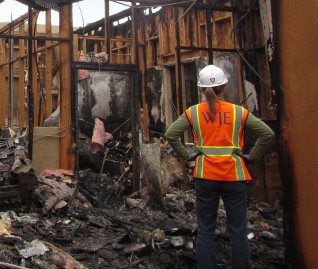
Thousands of clients have relied on us to accurately determine the cause and extent of damage... MORE >Services | Failure and Damage Investigation -
We employ our industrial rope access team or drone capabilities to provide clients a solution to... MORE >Services | Difficult Access and Drone Survey -
Clients turn to us when they need a firm that fully understands the aesthetic and functional... MORE >Services | Building Enclosures