























EXPERTISE // LABORATORIES // TESTING STANDARDS
Standard Method of Test for Uniaxial Tensile Response of Ultra-High-Performance Concrete
This test method covers sample preparation and testing of ultra-high performance concrete (UHPC) subjected to uniaxial tension. The objective of the test is to obtain the tensile stress–strain response and key response parameters of UHPC specimens. Some of the key parameters determined through this test are the elastic modulus, effective cracking strength and strain, peak tensile strength, strain at peak strength, localization strength, and localization strain. Furthermore, The AASHTO Guide Specifications for Structural Design with UHPC requires that the tensile properties of UHPC used for structural design be determined following AASHTO T397. Therefore, AASHTO T397 is the benchmark for the qualification of UHPC mixtures and the determination of UHPC design parameters.
To learn more about UHPC, watch the Advances in Ultra-High-Performance Concrete webinar where WJE materials engineers John Lawler and Elizabeth Wagner provide an overview of UHPC—including its constituent materials, mixture proportioning, and production processes—focusing on key differences between UHPC and conventional and high-performance concretes as well as on current and future uses of UHPC in architectural and structural applications. Check out the webinar here: https://www.wje.com/knowledge/webinars/detail/advances-in-uhpc
WJE laboratories are accredited by AASHTO (R18) and ANAB (ISO/IEC 17025) to perform testing standard AASHTO T397 for Standard Method of Test for Uniaxial Tensile Response of Ultra-High-Performance Concrete.
Contact us to learn more.
Keywords
AASHTO T 397 - Direct Tensile Test - Fiber Volume - Multicracking - Tensile Behavior - Ultra-High-Performance Concrete (UHPC)RELATED INFORMATION
-
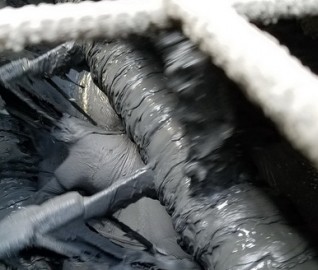 Learn about recent advances and comparative advantages of ultra-high-performance concrete. MORE >Webinars | Advances in Ultra-High-Performance Concrete
 -
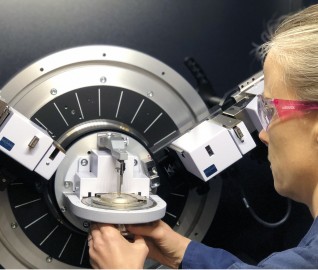 WJE's Janney Technical Center (JTC) provides advanced testing and forensic capabilities to... MORE >Labs | Janney Technical Center
 -
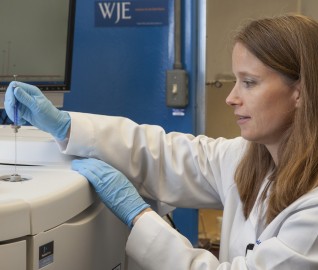 Our materials scientists provide comprehensive consulting services for the evaluation and... MORE >Services | Materials Evaluation and Testing
 -
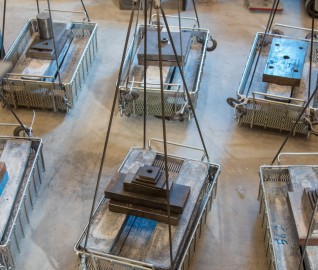 WJE was founded on a spirit of innovation—that everything can be improved and that... MORE >Services | Product Development, Evaluation, and Testing